“Killer Bouquets” or A Botanist’s Guide to Flowers and Fatality by Kate Khavari

Published June 6, 2023-Crooked Lane Books-352pp

Book Summary:

1920s London isn’t the ideal place for a brilliant woman with lofty ambitions. But research assistant Saffron Everleigh is determined to beat the odds in a male-dominated field at the University College of London. Saffron embarks on her first research study alongside the insufferably charming Dr. Michael Lee, traveling the countryside with him in response to reports of poisonings. But when Detective Inspector Green is given a case with a set of unusual clues, he asks for Saffron’s assistance.

The victims, all women, received bouquets filled with poisonous flowers. Digging deeper, Saffron discovers that the bouquets may be more than just unpleasant flowers— there may be a hidden message within them, revealed through the use of the old Victorian practice of floriography. A dire message, indeed, as each woman who received the flowers has turned up dead.

Alongside Dr. Lee and her best friend, Elizabeth, Saffron trails a group of suspects through a dark jazz club, a lavish country estate, and a glittering theatre, delving deeper into a part of society she thought she’d left behind forever.

Grateful Reader Review by Dorothy Schwab

The second installment in Kate Khavari’s Saffron Everleigh Mystery series, set in 1920’s London, features the old Victorian practice of Floriography. Khavari provides adequate backstory without spoiling the plot if readers decide to read the first installment, A Botanist’s Guide to Parties and Poisons.

 In this novel Khavari explores family expectations and the struggle of women in a male-dominated field. Saffron’s research career choice has created a “gulf of separation” within her family, connecting readers across generations to social and emotional truths of personal choices then and now. The tension in the professional and personal relationship between Saffron and her colleague, Dr. Michael Lee, is interspersed with infuriating dialogue, endearing body language, humorous situations, and life-saving discoveries!  Khavari’s characters are skillfully revealed through conflicts between several detectives and their attempts to solve the mystery involving three murders. She layers the murderous plot with exquisite descriptions of flowers and possible meanings while immersing readers in the eye-opening world of The Blue Room jazz club. The underworld of cocaine and its use in the past is brought to light as Saffron dons a beguiling disguise as Sally Eversby.

 Kate Khavari delivers “killer bouquets” filled with flowers of friendship, abandonment, and pain, arranged into a potent, perfumed mystery: A Botanist’s Guide to Flowers and Fatality.  

Book #1

Kate Khavari is the author of fiction ranging from historical mysteries to high fantasy epics. She has her parents to thank for her fascination for historical mysteries, as she spent the majority of her childhood memorizing Sherlock Holmes’s and Poirot’s greatest quips. A former teacher, Kate has a deep appreciation for research and creativity, not to mention the multitasking ability she now relies on as an author and stay at home mother to her toddler son. She lives in the Dallas-Fort Worth area of Texas with her husband, son, and a lovely garden that contains absolutely no poisonous plants.

Henderson House by Caren Simpson McVicker

Publishing Aug. 1, 2023-Inkshares-Historical Fiction, Romance- 434pp

Henderson House was provided by Galley Match for The Book Club CookBook

Grateful Reader Review by Dorothy Schwab

Henderson House is a relaxing respite from the busy world we live in. Caren Simpson McVicker’s debut novel is a flashback to 1940’s Bartlesville, Oklahoma and the simpler life of Wednesday night church suppers, Saturdays at the local cinema, and Sunday walks in the park after church. Based on family history and stories, Caren’s main character, Mildred Henderson, turns her grand home into a boarding house after the unexpected death of her husband. Mrs. H. and her beagle, Louie, captivate readers as she uses her special gifts- sensing houses and seeing a person’s color along with an interview checklist to choose her tenants. Frank Davis, a newly hired petroleum engineer at Philips Petroleum, checks all the boxes, changing the lives of the other boarders, the Blackwell family. In a few weeks’ time readers fall in love with Mrs. H.’s wisdom and Frank’s mild-mannered, genuine interest in the family, but most importantly his attraction to spinster Bessie, and where their friendship might lead.

Our group especially enjoyed the storytelling Caren weaves into the plot, along with the suspense of family secrets and sister loyalty. One of the threads in the novel is women in the workplace in the early 1940’s. We discussed jobs women from our past generations have held, from millinery shops in south Texas to restaurants in Germany! We shared our own versions of “self-talk,” kitchen ladies from church, and the supporting roles of the “menfolk” and their impact on the story. Dinners around the table with boarders recounting the day’s activities, special recipes shared, and even cooking lessons, make food and conversation a tantalizing feature.

Our menu from Caren’s Henderson House Recipe Collection: Appetizers- The Oklahoma Club Special drink, Edna’s Award-Winning Deviled Eggs, and Corn & Bean Salad w/lime dressing. Main course three salads-Waldorf, Cucumber & Tomato, and Chicken salad. Dessert- Mrs. H’s White Cake cupcakes with Buttercream Frosting. The “take-away” gift, a Boarder Interview Kit: a teapot filled with a stack of homemade almond shortbread cookies and lemon tea.

We unanimously loved Henderson House and are anxiously awaiting the sequel.

A Delectable Recipe for Summer Reading: A copy of Henderson House by Caren Simpson McVicker, two shortbread cookies, one cup of tea. Timeless storytelling perfection.  Dorothy Schwab, Hostess

Born in Oklahoma, Caren lives in Vermont with her hubby, rescue pup, and barn cat turned happy house kitty. Caren is also a mom to two incredible humans and is an enrolled member of the Cherokee Nation. Henderson House is her first novel.

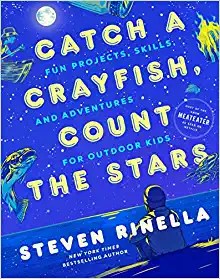
Catch a Crayfish, Count the Stars Fun Projects, Skills, and Adventures for Outdoor Kids

Published June 13, 2023-Random House-Children’s Nonfiction

Catch a Crayfish, Count the Stars

Fun Projects, Skills, and Adventures for Outdoor Kids

Grateful Reader Review by Dorothy Schwab

This is a “hands-on, gloves-off, muddy-boots” activity book for kids ages 8 and up. It’s divided into four sections: I-Navigation and Exploration, 2-Collecting and Foraging, 3-Fishing, Hunting, and Wildlife 4-Garden and Home. In the note to parents, Steven Rinella advises parents to take a survey of the activities to mark those that could be completed independently and those that would need supervision. From section 1, my eleven-year-old grandson chose “Pooping in the Woods,” to no one’s surprise. He liked that there were back-up plan suggestions for differing situations and learned the term cathole. My seven-year-old granddaughter chose “Build a Bug Hotel” from section 2. The directions were easy to follow and inspired her to head right to the kitchen to get the needed Mason jar and outside to hunt for the bugs. She learned the term specimen and wanted to immediately add the Picture Insect app to my phone. The additional information about a two-year-old finding a new species and having it named after her was a fun fact and a real-life connection.

                The activities are well explained, illustrated, and informative. Kids” of all ages will enjoy the projects and adventures. This is an activity book that will be applicable for many years and used over and over. Keep it handy and you’ll be ready to Catch a Crayfish, Count the Stars!

The Spectacular by Fiona Davis

Publication June 13, 2023-Penguin Group-Historical Fiction-368p

A LibraryReads Hall of Fame June pick
A Book of the Month Add-On
Recommended by Goodreads • New York Post • POPSUGAR • Reader’s Digest • AARP • SheReads

The Grateful Reader Review by Dorothy Schwab

Fiona Davis mesmerizes her fans with another novel set in an iconic building in New York City. In The Spectacular, Radio City Music Hall and the Rockettes take center stage. The opening act stars fifty-five-year-old Marion Brooks on moving day as she’s packing to leave her childhood home. That same evening in 1992, Marion is an honored guest at the 60th Anniversary of the Rockettes Celebration. Through a flashback of memories Marion shares the story and impact of her exhilarating time as a Rockette.

The Spectacular immerses readers in the1950’s frenzy and euphoria of the famous sisterhood known as the Rockettes.  Packed with research and history, she illuminates the try-outs, grand tours, and dance moves with optical illusions. From Radio City to the Rehearsal Club, a boardinghouse for girls in the performing arts to the family home in Bronxville, Davis choreographs a romance, a coming-of-age story, and the sixteen-year mystery of the famous “Big Apple Bomber.” The social and political handling of the manhunt and lack of success highlights the introverted Dr. Peter Griggs’ struggle to convince the police to use early psychological profiling. The male perspectives of Marion’s father and Nathaniel, her boyfriend create an emotional bridge connecting readers to the limited choices and infuriating parameters of young women in the 1950’s.  

This novel is about suffocating family dynamics, suppressing individuality while sacrificing dreams and the consequences, decisions that protect those we love, and taking a leap late in life. At the last curtain, The Spectacular earns Five dazzling stars!   

F  I  O  N  A D A V I S is the New York Times bestselling author of seven historical fiction novels set in iconic New York City buildings, including The Spectacular, The Magnolia Palace, The Address, and The Lions of Fifth Avenue, which was a Good Morning America book club pick. Her novels have been chosen as “One Book, One Community” reads and her articles have appeared in publications like The Wall Street Journal and O the Oprah magazine.

She first came to New York as an actress, but fell in love with writing after getting a master’s degree at Columbia Journalism School. Her books have been translated into over twenty languages and she’s based in New York City. Photo Credit Deborah Feingold

The Bookshop by the Bay by Pamela Kelley

Published June 6, 2023-St. Martin’s Press-Women’s Fiction-320pp

Grateful Reader Review by Dorothy Schwab

Southern Charm meets Cape Cod Living. Best friends since childhood, each married with a daughter, Jessica and Allison are at a crossroads in their lives. Needing new direction and time to focus, they reunite on Cape Cod where they grew up. This summer read is filled with contemplations, confessions, and second chances. Kelley explores relationships between grandmothers, mothers, and daughters, budding new couples and divorced couples, stale acquaintances refreshed, burgeoning business partnerships, and unsupportive snooty friends!  Pack all these relationships into one summer on Cape Cod, add a struggling bookshop, and readers have a satisfying, hope filled read. The Bookshop by the Bay checks all the beach read boxes.   

Pamela M. Kelley is a USA Today and Wall Street Journal bestselling author of women’s fiction, family sagas, and suspense. Readers often describe her books as feel-good reads with people you’d want as friends.

She lives in a historic seaside town near Cape Cod and just south of Boston. She has always been an avid reader of women’s fiction, romance, mysteries, thrillers and cook books. There’s also a good chance you might get hungry when you read her books as she is a foodie, and occasionally shares a recipe or two.

Hedge by Jane Delury

Published June 6, 2023-Zibby Books-

Hedge was highlighted by Oprah Daily as one of the Best New Books for Spring and by PEOPLE Magazine as one of the Best Books For Summer! 

Grateful Reader Review by Dorothy Schwab

In 2012, Maud is in a disintegrating marriage balancing the demands of motherhood. As a landscape historian in California, she takes on the restoration of Montgomery Place, a 19th century estate in New York’s Hudson Valley, which becomes a geographical and marital separation. Delury’s novel is filled with intricate historic gardening details and planning as Maud’s summer contract involves working with Gabriel, an archaeologist opening a dig in the same area. Reuniting at the end of their California school session, daughters Ella and Louise join Maud at Montgomery Place. The angst and instability of teenage daughter Ella adds a layer of turmoil to Maud’s developing relationship with Gabriel. Funding future projects depends on another budding relationship between wealthy recluse Alice Lincoln and Maud. Each of Delury’s slow growing, needy characters create emotional suspense layered with a hedge of secrecy.
Delury’s plot, twisting and turning like the garden labyrinth at Montgomery Place, sheds light on therapy for teenage fears and anxieties, marital communication and counseling, truth and trust in relationships, forgiveness, and finding a satisfying life path.

Jane Delury holds a BA in English and French literature from UC Santa Cruz, a maîtrise from the University of Grenoble, and an MA from the Johns Hopkins Writing Seminars. A professor at the University of Baltimore, she teaches in the MFA in Creative Writing & Publishing Arts and directs the BA in English. She lives in Baltimore with her daughters and her partner, the writer Don Lee.

SPOTLIGHT/EXCERPT: The Benevolent Society of Ill-Mannered Ladies by Alison Goodman

Publishing May 30, 2023-Berkley-Historical Fiction-Mystery & Thrillers-464pp

A high society amateur detective at the heart of Regency London uses her wits and invisibility as an ‘old maid’ to protect other women in a new and fiercely feminist historical mystery series from New York Times bestselling author Alison Goodman.

Excerpt:

“We should have worn half boots,” I said. “I can feel every pebble through my slippers.”

“One cannot wear half boots with full dress,” Julia said firmly. “Even in circumstances of duress.”

I stifled a smile. My sister’s sense of style and occasion was always impeccable, and rather too easy to poke.

Julia glanced sideways at me. “Oh, very funny. Next you’ll be suggesting we wear unmentionables.”

“If only we could,” I said. “Breeches would be far more convenient than silk gowns.”

“How would you know?” Julia demanded. “Heavens, Gus, you haven’t actually donned Father’s clothing, have you?”

She knew I had kept some of our father’s clothes after his death; he and I had been much the same height and wiry build. By all rights, the clothes belonged to our brother on his succession to the title-as all our father’s property did-but I had taken them, anyway. A connection to him and a memento mori of sorts.

“Of course not. I am only surmising.”

Julia settled back against my arm. “To even try them would be ghoulish.” She nudged me gently and angled her sweet smile up at me. “Even so, you would look rather dashing in, say, a hussars uniform. You have the commanding height for it, and the gold trim would match your hair.”

I snorted. Julia was, as ever, being too loyal. My brown hair did not even approach gold-in fact, it now had streaks of silver-and my five foot nine inches had so far in my life proved to be more awkward than commanding. She, on the other hand, had been blessed with the Colebrook chestnut hair, as yet untouched by age, and stood at a more dainty five foot two inches.

When we were children I had once cried because we were not identical. Our father had taken me aside and told me that he found such duplications unsettling and he was well satisfied with his two mismatched girls. He had been a good father and a better man. Yet in the eyes of society, his sordid death atop a rookery whore five years ago had become the sum of him.

It had nearly tainted my sister and me, too, for I had recklessly gone to the hovel to retrieve my father-I could not bear to think of his body gawped at by the masses, or as a source of their sport. As fate would have it, I was seen at the brothel. An unmarried woman of breeding should not even know about such places, let alone debase herself by entering one and speaking to the inhabitants. I became the latest on-dit and it was only the staunch support of our most influential friends that silenced the scandalmongers and returned us to the invitation lists.

A small group of middlings-the women with shawls clasped over dimity gowns and the men in belcher neckerchiefs and sober wools-clustered around a singer at the side of the path. The woman’s plaintive ballad turned Julia’s head as we passed.

“‘The Fairy Song,'” she said. “One of Robert’s favorites.”

I quickened our pace past the memory; fate seemed to be conspiring against me.

We attracted a few glances as we walked toward the gloomy entrance to the Dark Walk, mainly from women on the arms of their spouses, their thoughts in the tight pinch of their mouths.

“Maybe we should have brought Samuel and Albert,” Julia whispered. She had seen the matronly judgment too.

“Charlotte does not want our footmen knowing her business,” I said. “Besides, we are not quivering girls in our first season. We do not need to be chaperoned all the time.”

“Do you remember the code we girls made up to warn each other about the men in our circle?” Julia asked. “The code based on these gardens.”

“Vaguely.” I searched my memory. “Let me see: a Grand Walk was a pompous bore, a Supper Box was a fortune hunter . . .”

“And a Dark Walk was the reddest of red flags,” Julia said. “Totally untrustworthy, never be alone with him. It was based on all those awful attacks that happened in the Dark Walk at the time. Do you recall?”

I did-respectable young girls pulled off the path and assaulted in the worst way.

“That was more than twenty years ago, my dear. We are women of forty-two now, well able to look after ourselves.”

“That is not what Duffy would say.”

Indeed, our brother, the Earl of Duffield, would be horrified to know we had gone to Vauxhall Gardens on our own, let alone braved the lewd reputation of the Dark Walk.

“Duffy would have us forever hunched over embroidery or taking tea with every mama who saw her daughter as the new Lady Duffield.”

“True,” Julia said, “but you are so vehement only because you know this is beyond the pale. Not to mention dangerous.”

I did not meet her eye. My sister knew me too well.

“Well, we are here, anyway,” I said, indicating the Dark Walk to our right.

Huge gnarly oaks lined either side of the path, their overhanging branches almost meeting in the middle to make a shadowy tunnel of foliage. One lamp lit the entrance but I could see no other light farther along the path. Nor any other person.

“It lives up to its name,” Julia said.

We both considered its impenetrable depths.

“Should we do as Duffy would want and turn back?” I asked.

“I’d rather wear dimity to the opera,” Julia said and pulled me onward.

I knew my sister just as well as she knew me.

Excerpted from The Benevolent Society of Ill-Mannered Ladies by Alison Goodman Copyright © 2023 by Alison Goodman. Excerpted by permission of Berkley. All rights reserved. No part of this excerpt may be reproduced or reprinted without permission in writing from the publisher.

Alison is the author of seven novels, with her eighth, The Benevolent Society of Ill-Mannered Ladies, due out in May/June 2023.

Alison can dance a mean contra-dance, has a wardrobe full of historically accurate Regency clothes and will travel a long way for a good High Tea. She lives in Melbourne, Australia and was recently awarded her PhD at the University of Queensland so can now call herself Dr Al.

Photo courtesy of Tania Jovanovic

Secrets of the Italian Island by Barbara Josselsohn

Publishes May 11, 2023-Bookouture-Historical Fiction-Sisters of War-Book #1-393pp.

Grateful Reader Review by Dorothy Schwab

Barbara Josselsohn’s  foray into historical fiction begins with Secrets of the Italian Island. Based on a true story, this dual timeline is book #1 in the Sisters of War series. Main character Mia, grieving her grandmother Lucy’s recent passing in 2018, receives a letter claiming her grandmother is connected to an object of historical significance stolen from a castle on an island off the coast of Italy in the early 1940’s. Known as the Castle of the Poets for centuries, it had become a sanctuary for inventors, scientists, writers, and artists from all over the world. In the 1940’s the castle was stormed and overtaken by Nazis to house high ranking officials. The dual timeline continues with the saga of three sisters on a quest in 1943 to save their dying father. Papa, a Jewish tailor, should be leaving Italy, but due to his health must remain at home in his small village south of Rome. Annalise, oldest sister at 18 years old, has devised a daring plan to travel to the island, secure jobs in the castle kitchen, and find the owner, Patricio Parissi, who she hopes will help save her father.

Barbara Josselsohn’s well developed characters bridge the timelines for readers. In the current timeline, Mia’s boyfriend, Ryan, lacks empathy for her search to understand how the grandmother that raised her is somehow connected to a wedding dress found in a closet. When Mia travels to Italy, Ryan’s questioning phone calls and lack of support creates tension and distrust as the story progresses. Mia’s island tour guide, Leo, links readers to the latter timeline, as he shares the Parissi’s family history of the castle and the gruesome details of the Nazi takeover. Readers will also appreciate the impressive head of the castle kitchen, Signora Russo, and her intricate system of record keeping for guests in the castle.

Josselsohn’s prose is filled with anticipation, hope and fear in the sisters’ plan and her dialogue evokes emotions ranging from infuriating reactions to soul-stirring feelings shared on a dance floor. Along with analysis of the grandmother/granddaughter relationship readers can follow the sisters for an historic discovery and the threads of connection between artists and musicians of years past. Notes in walls and secrets leading to a love story on the Isola di Parissi, will be discovered in Secrets of the Italian Island.

All the Pretty Places by Joy Callaway

Publishes May 9, 2023-Harper Muse-Historical Fiction-400pp.

Grateful Reader Review by Dorothy Schwab

Joy Callaway’s All the Pretty Places transports readers to the Gilded Age of extravagant Fifth Avenue, New York mansions surrounded by elaborately landscaped gardens and terraces overflowing with palms, roses, peonies, and lilacs. The setting is Charlie Fremd’s Rye Nurseries, famous on the East Coast for rare and exotic plants but as the result of an economic downturn known as the Panic of 1893, his nursery is in peril. Main character Sadie Fremd is Charlie’s 22-year-old daughter, whose love and lifelong study of horticulture has prepared her to take over the nurseries when he retires. At the center of the family business crisis is that neither of Sadie’s brothers is interested in running the nurseries. The oldest son Charlie Jr., an adventurer, has been lured to Florida to design gardens for Hotel Royal Poinciana, and younger Freddie has gone to Chicago to follow political aspirations. Sadie’s father does not see her as a viable successor, believing “men should be about men’s work,” and she should be about getting married.

Meanwhile, Sadie develops her own strategies to save the family business. Stubborn and loyal, she rejects the debutante’s duty to marry and refuses several matches. Her heart belongs to Sam, a nursery worker who shares her love of horticulture, but left the area after a heartbreaking decision.  Readers will cheer Sadie on as she boldly confronts and rebuffs suitors her father continues to present. Anger literally seeps through the prose as he issues an ultimatum for her to marry or be sent to family in Germany until she consents.

Callaway creates emotional and familial conflict as true love, Sam, returns to Rye Nurseries. After life-changing experiences and much soul-searching Sadie confronts the fact that a mere five miles from the 5th Avenue mansions are tenements reeking of garbage and sewage. The vivid descriptions of the sights and smells capture the vast contradictions in the lifestyle and beauty surrounding the privileged as exquisite gardens and greenhouses bring their owners and readers a quiet, calming peace. But Sadie empathizes with those in the tenements dying of hopelessness. Don’t they deserve to appreciate the beauty of gardens in public parks?

The revelation that gardens and parks are beacons of hope for everyone blooms verdantly in the hearts of readers of All the Pretty Places.