The Secret Book of Flora Lea by Patti Callahan Henry

Publication April 2, 2024-Atria Books-Historical Fiction-Paperback-384pp

Book Summary


In the war-torn London of 1939, fourteen-year-old Hazel and five-year-old Flora are evacuated to a rural village to escape the horrors of the Second World War. Living with the kind Bridie Aberdeen and her teenage son, Harry, in a charming stone cottage along the River Thames, Hazel fills their days with walks and games to distract her young sister, including one that she creates for her sister and her sister alone—a fairy tale about a magical land, a secret place they can escape to that is all their own.

But the unthinkable happens when young Flora suddenly vanishes while playing near the banks of the river. Shattered, Hazel blames herself for her sister’s disappearance, and she carries that guilt into adulthood as a private burden she feels she deserves.

Twenty years later, Hazel is in London, ready to move on from her job at a cozy rare bookstore to a career at Sotheby’s. With a charming boyfriend and her elegantly timeworn Bloomsbury flat, Hazel’s future seems determined. But her tidy life is turned upside down when she unwraps a package containing an illustrated book called Whisperwood and the River of Stars. Hazel never told a soul about the imaginary world she created just for Flora. Could this book hold the secrets to Flora’s disappearance? Could it be a sign that her beloved sister is still alive after all these years?

Grateful Reader Review by Dorothy Schwab

Patti Callahan Henry’s dual time-line novel begins with the 1939 evacuation of children out of London known as Operation Pied Piper. Hazel Linden and her five-year-old sister, Flora Lea, have travelled by train to Oxford to escape the predicted London bombings. The lush description of the cottage at Binsey, the surrounding woodlands near the Thames, and the warm reception by Bridgette Aberdeen and her son Harry, allow readers a deep breath of relief. The sisters are distracted from the fears of war by “Bridie’s” daytime adventures, but at night with love and warmth, Hazel creates a fairy tale with a secret realm to comfort Flora Lea. The late-night imaginings whimsically named Whisperwood and the River of Stars, become the sisters’ personal, secret lifeline to survival. Patti Callahan Henry has created a mystical, magical, mystery within a mystery. In the depths of this novel’s soul is the disappearance of a fairy tale, Whisperwood and the River of Stars, along with Flora, into the river Thames.

Patti Callahan Henry transports readers from the banks of the Thames in 1940 to Hogan’s Rare Book Shoppe in Bloomsbury, London, 1960. Hazel has spent these last twenty years working and searching for Flora Lea, never giving up hope that she was alive.  Then on Hazel’s last day at the book shop before her dream job at Sotheby’s Auction House begins, a parcel arrives from America, an illustrated children’s book with the exact title of her secret realm; Whisperwood and the River of Stars.

The characters PCH creates make surprising choices and keep secrets out of love and protection from the truth. Realizing that “grief, confessions, and memories remain long, and dark and cold,” Henry’s readers learn the fear of discovering truth and who to blame creates trauma and its effect called memory reframing. As the mystery unfolds readers hopes are lifted and dashed as Hazel attempts to find the sender of the parcel, hoping, and praying the creator is Flora Lea. This novel is filled with heartbreak and hope; how to overcome fear, loneliness, loss, and find renewal, but most of all to hold tight and “never surrender to anyone else’s idea of who and what you should believe.”  

The beloved, elderly owner of Hogan’s Rare Book Shoppe once told Hazel, “Stories and books always find their rightful owners.” Life will become magical as rightful owners discover Patti Callahan Henry’s The Secret Book of Flora Lea.  

Highly recommended; 5 magical stars!

A New York Times Bestselling Author
Co-creator and co-host of the weekly web show and podcast  Friends & Fiction. Patti Callahan Henry is a New York Times and USA Today bestselling author of sixteen novels and podcast host. A full-time author, mother of three, and grandmother of two, she lives in Mountain Brook, Alabama with her husband, Pat Henry. Her newest novel, The Secret Book of Flora Lea, is set outside Oxford in the hamlet of Binsey, and will be released on May 2nd, 2023 with Simon & Schuster Atria.

The Lost Gift to the Italian Island by Barbara Josselsohn

Publication December 4, 2023-Bookouture-Historical Fiction-

Sisters of War Book 2

Book Summary

Italy, 1943. With tears in her eyes, Giulia listens out for the sound of bombers flying overhead and thinks of the baby growing inside of her. Through the fabric of her lace dress her fingers touch the cold bullets carefully sewn into the seams. Luca might never forgive her, but she has to do this…

New York, present day. When Tori Coleman discovers that her mother was adopted, her whole world shatters. Jeremy, her boyfriend, wants to get married, but how can Tori commit when she doesn’t know who she truly is? The only clue to the identity of her biological family is a mysterious postcard with a photograph of an ornate wedding dress her grandmother Giulia made, which she’s told was gifted to a museum on an Italian island…

Tori arrives on Parissi Island, surrounded by turquoise Mediterranean waters, with the sweet smell of orange blossom filling the air. She soon finds the museum and learns that Giulia was Jewish, and secretly lived there during World War Two. She thought her grandmother abandoned her mother, but was she forced to leave and give up her child?

Just as she’s getting closer to answers, an unexpected call from Jeremy stops Tori in her tracks. As he passionately urges her to find out the truth, suddenly Tori wishes he were in Italy by her side, ready to propose again.

But then Tori is shocked to find bullets sewn into the lining of one of Giulia’s dresses and a notebook claiming she did something terrible during World War Two. Will the secrets in her family help her follow her own heart, or send her home from Italy with it finally broken forever?

Grateful Reader Review by Dorothy Schwab-(Link to Review of Book 1 Below Author Bio)

The Lost Gift to the Italian Island, Book #2 in the Sisters of War, follows the plight of Giulia, as she escapes Parissi Island during the Nazi invasion and becomes entangled in the Italian Resistance. Barbara Josselsohn’s dual timeline alternates between 1943, Italy, and present-day New York City with several threads of mystery, betrayal, and secrecy. Josselsohn explores themes of following one’s passion and understanding identity through main character, Tori, a seamstress with goals of opening her own studio. A client sends Tori a postcard from a museum in Italy with a picture of the perfect wedding dress; some would believe this a coincidence, others God’s plan. As the designer and seamstress of my own wedding gown, this was the hook for me. Tori decides a trip to Italy to discover her past is manageable if she treats it as a dress pattern, one step at a time- the perfect analogy. Sensory descriptions of the castle, Parissi Island, and the Mediterranean are the ultimate setting as Tori discovers that mistakes and misunderstandings are the pieces to her past.

While life lessons like choose life-give the future a chance, and the antidote to mistrust is connection, are important, I believe the key to The Lost Gift of the Italian Island is that “love transcends everything.” Tori’s promise from her mother is one that connects us all.  “Wherever you go, I will go, and wherever you stay, I will stay. Your people will be my people and your God my God.”  

Memorable historical details of situations with uplifting outcomes. Highly recommended.

A best-selling novelist with a background in newspaper reporting, Barbara Josselsohn loves crafting stories about protagonists facing a fork in the road. She is the author of six novels and has also written hundreds of articles and essays in major and regional publications about family, home and relationships. Barbara’s stunning website: https://barbarajosselsohn.com/

A Christmas Vanishing by Anne Perry

Publication: November 7, 2023-Random House-Ballantine-Historical Mystery

Book Summary

Charlotte Pitt’s clever grandmother investigates the sudden disappearance of her dear friend in this chilling holiday whodunit by New York Times bestselling author Anne Perry.

Mariah Ellison, Charlotte Pitt’s grandmother, accepts her longtime friend Sadie’s gracious invitation to spend Christmas with her and her husband, Barton, in their picturesque village. But upon arrival, Mariah discovers that Sadie has vanished without a trace, and Barton rudely rescinds the invitation. Once Mariah finds another acquaintance to stay with during the holiday season, she begins investigating Sadie’s disappearance.

Mariah’s uncanny knack for solving mysteries serves her well during her search, which is driven by gossip as icy as the December weather. Did Sadie run off with another man? Was she kidnapped? Has someone harmed her? Frustratingly, Mariah’s questions reveal more about the villagers themselves than about her friend’s whereabouts. Yet in the process of getting to know Sadie’s neighbors, Mariah finds a kind of redemption, as she rediscovers her kinder side, and her ability to love. 

It is up to Mariah to master her own feelings, drown out the noise, and get to the bottom of what occurred, all before Christmas day. With the holiday rapidly approaching, will she succeed in bringing Sadie home in time for them to celebrate it together—or is that too much to hope for?

Grateful Reader Review by Dorothy Schwab

A Christmas Vanishing takes place during a miserable winter, outside foggy, sooty London, around the turn of the century. Anne Perry’s vivid descriptions of the English countryside whisk readers by train to a quaint village green with decorated shop fronts, the aroma of roasting chestnuts, and church bells that peal to gather the townspeople. Main character, Mariah, is escaping demons from her past, an unhappy marriage, and the person she has become. Anne Perry’s ability to peer deep into Mariah’s past and express her heartfelt misgivings and admitted mistakes, illuminates human frailties in Mariah, the townspeople, and in ourselves. Who invites a guest for Christmas and then disappears? Sadie, Mariah’s confidant from decades past, is described as spirited and engaging. The severe cold, approaching Christmas Eve, and her place in village society makes Sadie’s disappearance quite disturbing and mysterious. Is Sadie being selfish or is she desperate? Will the townspeople solve the mystery in time for Christmas? Anne Perry’s A Christmas Vanishing deals with mistakes, repaying old debts, and forgiveness. Listen for the church bells!

Anne Perry passed in April 2023. I’ve enjoyed reading and reviewing her annual Christmas novels for many years. Read about her incredible career in her own words: https://anneperry.us/about-me/

Anne Perry : 28 October 1938 – 10 April 2023

Anne’s publishing career began with The Cater Street Hangman. Published in 1979, this was the first book in the series to feature the Victorian policeman Thomas Pitt and his well-born wife Charlotte. This is arguably the longest sustained crime series by a living writer. Murder on the Serpentine is the latest (32nd) in the series.  She has now started a series featuring their son Daniel, beginning with 21 Days (2017).

In 1990, Anne started a second series of detective novels with The Face of a Stranger. These are set about 35 years before and features the private detective William Monk and volatile nurse Hester Latterly. The most recent of these (24th in the series) is Dark Tide Rising.

The Spectacular by Fiona Davis

Publication June 13, 2023-Penguin Group-Historical Fiction-368p

A LibraryReads Hall of Fame June pick
A Book of the Month Add-On
Recommended by Goodreads • New York Post • POPSUGAR • Reader’s Digest • AARP • SheReads

The Grateful Reader Review by Dorothy Schwab

Fiona Davis mesmerizes her fans with another novel set in an iconic building in New York City. In The Spectacular, Radio City Music Hall and the Rockettes take center stage. The opening act stars fifty-five-year-old Marion Brooks on moving day as she’s packing to leave her childhood home. That same evening in 1992, Marion is an honored guest at the 60th Anniversary of the Rockettes Celebration. Through a flashback of memories Marion shares the story and impact of her exhilarating time as a Rockette.

The Spectacular immerses readers in the1950’s frenzy and euphoria of the famous sisterhood known as the Rockettes.  Packed with research and history, she illuminates the try-outs, grand tours, and dance moves with optical illusions. From Radio City to the Rehearsal Club, a boardinghouse for girls in the performing arts to the family home in Bronxville, Davis choreographs a romance, a coming-of-age story, and the sixteen-year mystery of the famous “Big Apple Bomber.” The social and political handling of the manhunt and lack of success highlights the introverted Dr. Peter Griggs’ struggle to convince the police to use early psychological profiling. The male perspectives of Marion’s father and Nathaniel, her boyfriend create an emotional bridge connecting readers to the limited choices and infuriating parameters of young women in the 1950’s.  

This novel is about suffocating family dynamics, suppressing individuality while sacrificing dreams and the consequences, decisions that protect those we love, and taking a leap late in life. At the last curtain, The Spectacular earns Five dazzling stars!   

F  I  O  N  A D A V I S is the New York Times bestselling author of seven historical fiction novels set in iconic New York City buildings, including The Spectacular, The Magnolia Palace, The Address, and The Lions of Fifth Avenue, which was a Good Morning America book club pick. Her novels have been chosen as “One Book, One Community” reads and her articles have appeared in publications like The Wall Street Journal and O the Oprah magazine.

She first came to New York as an actress, but fell in love with writing after getting a master’s degree at Columbia Journalism School. Her books have been translated into over twenty languages and she’s based in New York City. Photo Credit Deborah Feingold

SPOTLIGHT/EXCERPT: The Benevolent Society of Ill-Mannered Ladies by Alison Goodman

Publishing May 30, 2023-Berkley-Historical Fiction-Mystery & Thrillers-464pp

A high society amateur detective at the heart of Regency London uses her wits and invisibility as an ‘old maid’ to protect other women in a new and fiercely feminist historical mystery series from New York Times bestselling author Alison Goodman.

Excerpt:

“We should have worn half boots,” I said. “I can feel every pebble through my slippers.”

“One cannot wear half boots with full dress,” Julia said firmly. “Even in circumstances of duress.”

I stifled a smile. My sister’s sense of style and occasion was always impeccable, and rather too easy to poke.

Julia glanced sideways at me. “Oh, very funny. Next you’ll be suggesting we wear unmentionables.”

“If only we could,” I said. “Breeches would be far more convenient than silk gowns.”

“How would you know?” Julia demanded. “Heavens, Gus, you haven’t actually donned Father’s clothing, have you?”

She knew I had kept some of our father’s clothes after his death; he and I had been much the same height and wiry build. By all rights, the clothes belonged to our brother on his succession to the title-as all our father’s property did-but I had taken them, anyway. A connection to him and a memento mori of sorts.

“Of course not. I am only surmising.”

Julia settled back against my arm. “To even try them would be ghoulish.” She nudged me gently and angled her sweet smile up at me. “Even so, you would look rather dashing in, say, a hussars uniform. You have the commanding height for it, and the gold trim would match your hair.”

I snorted. Julia was, as ever, being too loyal. My brown hair did not even approach gold-in fact, it now had streaks of silver-and my five foot nine inches had so far in my life proved to be more awkward than commanding. She, on the other hand, had been blessed with the Colebrook chestnut hair, as yet untouched by age, and stood at a more dainty five foot two inches.

When we were children I had once cried because we were not identical. Our father had taken me aside and told me that he found such duplications unsettling and he was well satisfied with his two mismatched girls. He had been a good father and a better man. Yet in the eyes of society, his sordid death atop a rookery whore five years ago had become the sum of him.

It had nearly tainted my sister and me, too, for I had recklessly gone to the hovel to retrieve my father-I could not bear to think of his body gawped at by the masses, or as a source of their sport. As fate would have it, I was seen at the brothel. An unmarried woman of breeding should not even know about such places, let alone debase herself by entering one and speaking to the inhabitants. I became the latest on-dit and it was only the staunch support of our most influential friends that silenced the scandalmongers and returned us to the invitation lists.

A small group of middlings-the women with shawls clasped over dimity gowns and the men in belcher neckerchiefs and sober wools-clustered around a singer at the side of the path. The woman’s plaintive ballad turned Julia’s head as we passed.

“‘The Fairy Song,'” she said. “One of Robert’s favorites.”

I quickened our pace past the memory; fate seemed to be conspiring against me.

We attracted a few glances as we walked toward the gloomy entrance to the Dark Walk, mainly from women on the arms of their spouses, their thoughts in the tight pinch of their mouths.

“Maybe we should have brought Samuel and Albert,” Julia whispered. She had seen the matronly judgment too.

“Charlotte does not want our footmen knowing her business,” I said. “Besides, we are not quivering girls in our first season. We do not need to be chaperoned all the time.”

“Do you remember the code we girls made up to warn each other about the men in our circle?” Julia asked. “The code based on these gardens.”

“Vaguely.” I searched my memory. “Let me see: a Grand Walk was a pompous bore, a Supper Box was a fortune hunter . . .”

“And a Dark Walk was the reddest of red flags,” Julia said. “Totally untrustworthy, never be alone with him. It was based on all those awful attacks that happened in the Dark Walk at the time. Do you recall?”

I did-respectable young girls pulled off the path and assaulted in the worst way.

“That was more than twenty years ago, my dear. We are women of forty-two now, well able to look after ourselves.”

“That is not what Duffy would say.”

Indeed, our brother, the Earl of Duffield, would be horrified to know we had gone to Vauxhall Gardens on our own, let alone braved the lewd reputation of the Dark Walk.

“Duffy would have us forever hunched over embroidery or taking tea with every mama who saw her daughter as the new Lady Duffield.”

“True,” Julia said, “but you are so vehement only because you know this is beyond the pale. Not to mention dangerous.”

I did not meet her eye. My sister knew me too well.

“Well, we are here, anyway,” I said, indicating the Dark Walk to our right.

Huge gnarly oaks lined either side of the path, their overhanging branches almost meeting in the middle to make a shadowy tunnel of foliage. One lamp lit the entrance but I could see no other light farther along the path. Nor any other person.

“It lives up to its name,” Julia said.

We both considered its impenetrable depths.

“Should we do as Duffy would want and turn back?” I asked.

“I’d rather wear dimity to the opera,” Julia said and pulled me onward.

I knew my sister just as well as she knew me.

Excerpted from The Benevolent Society of Ill-Mannered Ladies by Alison Goodman Copyright © 2023 by Alison Goodman. Excerpted by permission of Berkley. All rights reserved. No part of this excerpt may be reproduced or reprinted without permission in writing from the publisher.

Alison is the author of seven novels, with her eighth, The Benevolent Society of Ill-Mannered Ladies, due out in May/June 2023.

Alison can dance a mean contra-dance, has a wardrobe full of historically accurate Regency clothes and will travel a long way for a good High Tea. She lives in Melbourne, Australia and was recently awarded her PhD at the University of Queensland so can now call herself Dr Al.

Photo courtesy of Tania Jovanovic

Coronation Year by Jennifer Robson

Publishing April 4, 2023-William Morrow-400pp

A royal-adjacent historical novel: Check out Jennifer’s Facebook page for all her posts and research: https://www.facebook.com/AuthorJenniferRobson/posts/pfbid02HfQxTE6EnjxNZLQN7WfuwQxnASM5SATE3eVhxiPmZZqhn8RP6m48pvT4YCBDhgMAl

The Grateful Reader Review by Dorothy Schwab

Jennifer Robson’s Coronation Year captures the thrill and majesty of the year leading up to Queen Elizabeth’s Coronation Day, June 2, 1953. Readers view the approaching day from three different perspectives. Main character Edie Howard, proprietor of the 400-year-old Blue Lion Hotel, is desperately trying to keep the hotel in the “black.”  News that the floundering hotel is right on the Coronation Day route might be the business boost Edie needs.  Two other Blue Lion residents that play an important role in the year leading up to Coronation Day are Stella Donati, Italian photographer and Holocaust survivor, and Jamie Geddes, a Scottish artist of Indian heritage, a war hero. Robson seamlessly threads their personal stories into Blue Lion activities and the planning of royal events.

Robson’s novel, like an English trifle, is one delicious layer after another. The foreboding nightmares, compelling memories, and catastrophic situations Stella and Jamie have endured are sweetened in the narrative by the genuinely compassionate, supportive nature of Edie. Robson convincingly reveals Edie’s anxiety and stress as Coronation Day plans begin to unravel. With the receipt of anonymous threatening letters, what was at first a hectic but jolly lead up to the big day takes a sinister, mysterious turn. Readers endure the weight and tension of the impending deadline stretching right up to Coronation Day.  

Robson’s descriptions of the parks, iconic buildings, and statues bring London to life as readers are swept into the hysteria and mass of humanity surrounding preparations and the ceremony itself.  As the new “telly” is installed in the Blue Lion lobby for residents and millions from around the world to view, throngs of royal followers are packed right out front, madly waving the Union Jack in wild anticipation of the queen in her golden coach.

Put on a pot of tea and get a glimpse of royal pageantry as a menacing mystery unfolds on June 2, the biggest day in 1953, Coronation Year.

“An academic by background, a former editor by profession, and a lifelong history nerd, I’m the author of seven novels set during and after the two world wars: Somewhere in FranceAfter the War is OverMoonlight Over ParisGoodnight from LondonThe Gown, Our Darkest Night, and Coronation Year. I was also a contributor to the acclaimed anthology Fall of Poppies: Stories of Love and the Great War.

I was born and raised in Peterborough, Ontario. I studied French literature and Modern History as an undergraduate at King’s University College at Western University, then attended Saint Antony’s College at the University of Oxford, where I obtained my doctorate in British economic and social history. While at Oxford I was a Commonwealth Scholar and SSHRC Doctoral Fellow.

I live in Toronto, Canada, with my husband and children, and share my home office with Bonnie the sheepdog and her feline companions Mika, Rachel and Obi.

My photograph was taken in September, 2022 by Megan Preece.”

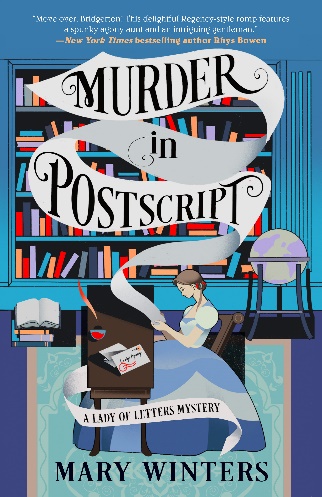
Murder in Postscript by Mary Winters

Publishes March 28-Berkley-Historical Mystery-320pp.

Grateful Reader Review by Dorothy Schwab

Mary Winters sets her newest novel, Murder in Postscript, in Victorian England. Amelia Amesbury, the lovely widow, mother, and countess, is the main character in the first of the Lady Agony Mystery Series.  Amelia, pen name Lady Agony, writes secretly for a London penny paper dishing out advice on topics from fashion to social faux pas. She waits anxiously for the post each day so she can retreat to the two-story library in the home she shared with her late husband Edgar and his young niece, Winifred, now like a daughter. The day Lady Agony receives a letter from a lady’s maid pleading, “I think my mistress was murdered,” is the day Lady Agony turns to solving a murder instead of giving advice.

Mary Winters’ characters are either likeable or unlikeable. Readers meet Amelia’s Aunt Tabitha, who is mostly unlikeable due to her overbearing attitudes regarding widowhood and constant comments to behave; reminding Amelia she has married into gentry and must meet certain expectations. Nagging and disapproving looks are her specialty. In contrast to Tabitha is the extremely likeable Lord Simon Bainbridge. He’s easy going, well mannered, and has a surprising, even unnerving sense of humor. As Winters “who done it” plot unfolds, she cleverly weaves an intricate trail for Amelia and Simon to follow as they attend costume balls, traipse to the London docks, and visit a crazy aunt in her English garden. While tracking down clues the Simon/Amelia relationship continues to ebb and flow while visiting chocolate shops and in carriage rides, keeping readers hopeful as they share empathy for each other’s pasts.

Each charming chapter opens with a letter to Lady Agony and the pearls of wisdom she so forthrightly imparts. With Winnifred’s recital to host and a killer still on the loose, Lady Agony’s last bit of advice is “do less and enjoy more!”  So, mind your manners and read Murder in Postscript, the first in The Lady Agony Mystery Series.

“Trust me.” Yours in Secret, Lady Agony

Murder in Postscript by Mary Winters

Publishes March 28-Berkley-Historical Mystery-320pp.

Excerpt

Winifred gave Amelia an impulsive hug, and Amelia breathed in the beautiful strawberry scent of the child. Edgar hadn’t given her love—­he wouldn’t risk passing on his degenerative condition— ­but he had given her his dear niece, and for that, Amelia would always be grateful.

When the girl was gone, Amelia took the letters into the library, her favorite room in the house. It was something else Edgar had given her that she’d enjoyed very much—­a home with books. While the Feathered Nest had plenty of room for dining and entertaining, it did not afford much room for books, just the special theatricals the family loved and performed. One of her favorite performances was Romeo and Juliet, probably because she and Grady were central characters. Most times her eldest sister, Penelope, took the lead roles. Indeed, Penelope was better at memorizing lines, but Amelia was better at improvising.

She stopped and inhaled a breath. The room smelled of cloves and paper and past cigars. Hundreds of leather-­bound tomes filled the wooden bookshelves that lined the two-­story room. She bypassed the books and made for the large rosewood desk, situated in a bright alcove of windows. It faced a dark green couch, striped chairs, and an ornate oval table. In a nearby corner was a smaller table, with heavy crystal glasses and fine liquor. And on the far wall was a grand stone fireplace, surrounded by two soft damask chairs, comfortable enough for reading and dozing. She’d spent many nights there doing just that.

Slice went the letter opener, revealing the contents for her eyes only. She scanned the penmanship: hurried, sloppy, and slightly smudged from tears. Definitely a relationship problem. Settling into her chair, she began to read the letter.

Dear Lady Agony,

You are a lady of repute. Please tell me what to do. I love the boy next door, but he’s unaware of my feelings. I am certain we possess a special bond, for he smiles at me so. But he’s going to ask another girl to marry him. He told me his plan on the way to the well. I stumbled away, confused, but how I longed to tell him the truth of my feelings. Am I too late?

Devotedly,

Too Late for Love

Amelia dunked her quill in the ink. This one was easy, a drop in the bucket of love letters. She began her response, which would be printed in the magazine. Readers’ letters weren’t included, and a good thing, too. Amelia had a feeling many writers would be embarrassed later by the emotion they’d poured into their requests.

Dear Too Late for Love,

It’s never too late for love. In fact, I prefer the old, and perhaps wiser, adage, Better Late than Never. In your case, it cannot be truer. You love the boy and are late to admit it. Yes. However, there is still time. He hasn’t asked anyone to marry—­yet. Best he knows your true feelings before he proceeds. Even if he does not reciprocate them, you will feel secure in the knowledge that you told him. And that is a feeling you can live with. The other is not.

Yours in Secret,

Lady Agony

The next letter was just as clear-­cut. It was from a reader who was jealous of her friend’s hair, though she didn’t say so outright. The letter accused the friend of spending too much time dressing her long, blonde, thick locks, but it was obvious to Amelia that the letter writer wished for the hair herself.

Another dunk into the inkwell, and Amelia was poised to respond.

Dear Hair, There, and Everywhere,

Some women are born with great hair. Others are born with great wit, vivacity, or kindness. Cultivate one of the latter. Or purchase a wig. The choice is just that simple.

Yours in Secret,

Lady Agony

She waited a moment before opening the last letter, savoring the unknown contents. It would be tomorrow afternoon before she received more letters, the mysteries that made up her day. Because of the popularity of the column, Grady made certain the letters arrived daily so that she wouldn’t fall behind.

She turned the envelope over in her hands, positioning it in front of the light. A few drops of spring sunshine shone through the windows, making burgundy flecks on the wall as it bounced off the nearby decanter of brandy. Soon a housemaid would be in to start a fire, to warm the chill brought on by the late afternoon. Then Amelia would enjoy a glass of sherry before dressing for dinner, a complicated affair that she had never quite mastered.

She noted the seal of the envelope had been hastily done. Dashed out at the last minute, perhaps, the letter might contain time-­sensitive information. Amelia unfolded the paper. The handwriting, no better than chicken scratch, was hard to decipher. Written at a slant, possibly in this morning’s rain burst, it was wrinkled and marked. Yet the writer’s desperation was clear from the first sentence. Amelia scanned the letter twice before dropping her quill, splattering ink on the desk. She grabbed her spectacles and read it a third time. Her eyes must be deceiving her. It was indeed dated this morning.

Dear Lady Agony,

You are my last hope, for I have nowhere else to turn. Could you meet me at St. James’s Park at nine o’clock this evening? Make sure no one follows you. I believe someone is following me. I’ll be at the bench by the pond. You will know me by my red hat. Please make every effort. I’ve witnessed something dreadful, and I fear the worst.

Devotedly,

Charlotte

Postscript: I think my mistress was murdered.

Excerpted from Murder in Postscript by Mary Winters Copyright © 2023 by Mary Winters. Excerpted by permission of Berkley. All rights reserved. 

The Maid of Ballymacool by Jennifer Deibel

Publication February 21, 2023-Revell Christian-Historical Fiction, Romance-352 pp

The Grateful Reader Review by Dorothy Schwab

An enchanting Cinderella story that keeps readers hoping for that ‘happily ever after.’ The setting for Jennifer Deibel’s The Maid of Ballymacool is Ireland, 1935. She has included all the necessary characters for a fairy tale set in the twentieth century. Main character, Brianna Kelly is the abandoned baby left on a doorstep with directions for her care. The stepmother role is played by rejected Maureen Magee, headmistress of the Ballymacool House and Boarding School for Girls; where baby Brianna is condemned to a lonely, rootless life of solitude. Brianna’s only friend is Finnuala, a wise, auld woman who lives in the woods where Brianna escapes to find peace and beauty; away from the beatings and abuse she receives from the dreaded Magee. From what seems like another world and yearning for a purposeful life, comes the handsome prince, kind, compassionate, book lover Michael Wray of nearby Castle Wray. Michael is sent to help discipline his obnoxious, ill-mannered cousin, Adeline, a boarder at Ballymacool; a well written bratty character to dislike.  The only link to Brianna’s past is a chain with a pendant bordered with fleur de lis and hand carved letters on the back.

Jennifer Deibel deftly weaves mystery and romance into this tale along with lush descriptions of Castle Wray; its history, its grounds and Ballymacool’s aging, dreary interiors but peaceful surrounding woods. As the mystery unfolds between the House of Ballymacool, the guest cottages, and the woods, the characters slowly develop fresh hope, trust, and a need for forgiveness.  Securing the bonds of family and the importance of finding one’s true identity are key themes that make The Maid of Ballymacool a delightful, fulfilling Cinderella story.  

Jennifer Deibel is a middle school teacher and freelance writer. Her work has appeared on (in)courage, on The Better Mom, in Missions Mosaic Magazine, and others. With firsthand immersive experience abroad, Jennifer writes stories that help redefine home through the lens of culture, history, and family. After nearly a decade of living in Ireland and Austria, she now lives in Arizona.https://www.jenniferdeibel.com/

Under a Veiled Moon by Karen Odden

Published October 11, 2022 by Crooked Lane Books -Historical Fiction, Crime Mystery, 336pp.

An Inspector Corravan Mystery

Grateful Reader Review by Dorothy Schwab

Fans of crime mystery set in Victorian London will be thrilled with Under a Veiled Moon, a sequel to Karen Odden’s Down a Dark River. The mystery is based on the fatal disaster of the sinking of a pleasure steamer on the River Thames in September,1878.  The steamer, Princess Alice collided with coal carrier, Bywell Castle, with only 130 of 600 passengers surviving. This tragedy is shrouded in mystery and known as the worst maritime disaster London had seen at that time.

Under a Veiled Moon, book #2 in the Inspector Corravan Mystery Series, is easily read as a stand-alone novel. Odden transports readers to Victorian London through sensory descriptions of the deserted warehouses, tunnels, and cathedral priest holes as Scotland Yard’s Inspector Corrovan follows leads up and down the dark, twisting streets of East London’s Whitechapel. Odden connects readers to present day issues of fake news in current media by weaving the history of racism and persecution of the Irish with how “distortions and manipulations” in the press drastically impacted anti-Irish sentiment and public opinion. This created doubt and suspicions on all sides of the political issues. Odden couples the inspector’s frantic quest to uncover the possible instigator of the horrific disaster with the background of the Irish Republican Brotherhood, the push for Irish Home Rule, and the secret societies formed by powerful Conservative MP’s.

The murder suspects are motivated by fear, love, revenge, and greed, while Corrovan is overcome at times with grief, regret, shame, and pain.  Filled with wise, insightful characters along with those not so likeable, readers will be fascinated with the clues to this mysterious tragedy that happened late one night on the Thames Under a Veiled Moon.

Karen received her Ph.D. in English literature from New York University and subsequently taught at the University of Wisconsin-Milwaukee. Her first novel, A Lady in the Smoke, was a USA Today bestseller and A Dangerous Duet and A Trace of Deceit have won awards for historical mystery and historical fiction. Under a Veiled Moon, her fifth mystery is the second book in the Inspector Corravan series.